
France has had an enormous impact on world culture, dating back to the 18th century and the French Revolution. The French Revolution remains one of the most transformative moments in human history, a period when French citizens challenged centuries‑old hierarchies, demanded civil rights, and reshaped the cultural landscape of France and Europe. Its profound impact reverberated far beyond the monarchy’s fall, influencing art, music, literature, political institutions, and the very ideals of liberty that continue to guide modern societies. What began as an uprising against economic upheaval and political inequality evolved into a revolutionary movement that left an indelible mark on global culture and consciousness.
While this post provides an overview of France’s influence on global policies and culture, particularly how “public opinion” influenced political change, individual posts will highlight other aspects of cultural change. Click on the topics below to access the more specific posts:
- French Cuisine Worldwide (under development)
- French Architecture Abroad (under development)
- French Language Influence (under development)
- French Art & Impressionism
Contents
- 1 Liberty, Individualism, and the Birth of Modern Rights
- 2 French Salons: The Crucible of Free Speech and Liberalism
- 3 Abolition of Slavery and the Haitian Revolution
- 4 Women and the Revolutionary Reimagining of Society
- 5 Impact on Music: Beethoven, Schubert, and Chopin
- 6 The Rise of Romanticism
- 7 The End of Feudalism and the Transformation of European Society
- 8 A Lasting French Impact on Human History
- 9 Visit Our Other France and Paris Posts
Liberty, Individualism, and the Birth of Modern Rights
At the heart of the Revolution was a radical reimagining of what it meant to be a citizen. The Declaration of the Rights of Man and of the Citizen, adopted in 1789, articulated principles that were revolutionary for their time: legal equality, property ownership, representative government, and the inherent rights of ordinary citizens. These ideals of liberty and individualism challenged the divine-right monarchy and the rigid feudal system that had dominated European society for centuries.
The Revolution’s emphasis on individual rights inspired political reforms across Europe and later influenced movements for equal rights, civil rights, and constitutional government worldwide. The notion that people—not kings, not religious figures—were the legitimate source of political authority marked a radical change in public opinion and political philosophy.
This shift in collective identity created a new sense of nationalism among the French people, embodied in symbols like La Marseillaise, the French National Anthem, which became a rallying cry for freedom and unity.
The revolutionaries of the nineteenth century borrowed images as well as ideas from the French Revolution. The most famous of those images was that of ‘Liberty’. Liberty was portrayed as a young woman, Marianne, and she appeared in countless pictures, statues and models throughout the French Revolution.

The Revolution taught citizens to see themselves not as subjects, but as active participants in shaping their nation’s future.
Perhaps the most famous image of liberty (and Marianne) is the Statue of Liberty (below) at the entrance to New York harbor. This 200 tonne, 97m high copper statue was a gift to the United States from the French people to show the friendship between their two republics. It was suggested by a French historian to commemorate the 100th anniversary of American independence.

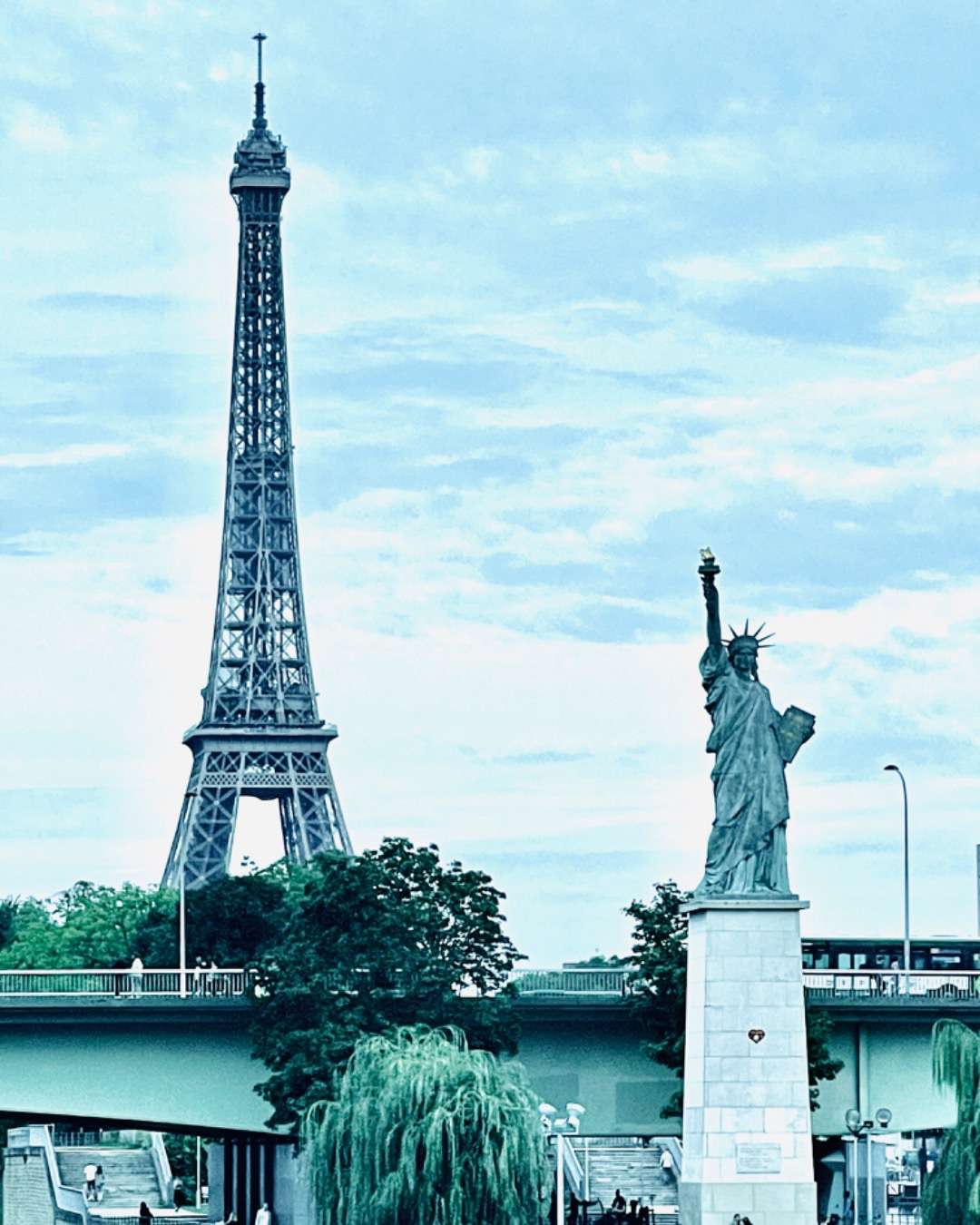
The Statue of Liberty in Paris?
In the USA we are all thankful that France gave us the Statue of Liberty, a symbol of liberty, freedom, and enlightenment — both for the United States and for people around the world. However, we never knew that there was another one in Paris until we took the cruise on the Seine River. Who knew that there were more Statues of Liberty than the one in New York City? There are at least eight: five or six in Paris, one in Argentina, and of course NYC.
French Salons: The Crucible of Free Speech and Liberalism
Long before the storming of the Bastille, French salons played an important role in nurturing the intellectual climate that made revolution possible. Hosted often by influential women in their homes, these salons were spaces where philosophers, writers, artists, and political thinkers debated ideas about governance, religion, and society. Unlike the formal Salon de Paris, which had central control over defining what was acceptable art, the home salons, allowed artists to experiment with new concepts, and hence Impressionism was created.
Salons encouraged:
- Free speech
- Liberalism
- Critical thinking
- The spread of Enlightenment ideals
They allowed French politics to be discussed openly, challenging censorship and the authority of the French monarchy.. In many ways, salons were the incubators of revolutionary thought, shaping the minds of future leaders—including the occasional member of the National Convention—and inspiring the public to question long-standing traditions.
Abolition of Slavery and the Haitian Revolution
One of the Revolution’s most significant global legacies was its influence on the Haitian Revolution, the only successful slave uprising in world history. Inspired by the ideals of liberty and the promise of legal equality, enslaved people in Saint-Domingue rose up against French colonial rule.
The Haitian Revolution forced France to confront the contradiction between its revolutionary principles and its colonial practices. In 1794, the National Convention abolished slavery throughout French territories—a monumental step in the global fight for human rights.
Although Napoleon later reinstated slavery in some colonies, the Haitian Revolution’s success permanently weakened European colonialism and demonstrated that the revolutionary spirit could transcend borders, race, and class.
Women and the Revolutionary Reimagining of Society
The Revolution also sparked debates about the role of women in society. Women marched to Versailles, demanded bread, and insisted that the Revolution’s promises apply to them as well. Figures like Olympe de Gouges, who authored the Declaration of the Rights of Woman and of the Female Citizen, argued that women deserved equal rights, education, and political participation.
While the Revolution did not fully deliver on these demands, it undeniably shifted public opinion. Women’s activism during this period laid the groundwork for future feminist movements and challenged traditional gender roles. The image of the young woman standing at the barricades became a powerful symbol of courage and civic responsibility.
Impact on Music: Beethoven, Schubert, and Chopin
The Revolution’s cultural impact extended deeply into the world of music. Composers across Europe were inspired by the themes of heroism, struggle, and liberation.

French Influence on Beethoven
Beethoven admired the Revolution’s ideals and initially dedicated his Eroica Symphony to General Napoleon Bonaparte, whom he saw as a champion of freedom. Although he later withdrew the dedication when Napoleon crowned himself emperor, the symphony’s bold, emotional style reflected the rise of Romanticism and the revolutionary spirit.
French Influence on Schubert
Schubert’s works often explored themes of longing, individuality, and emotional depth—hallmarks of the Romantic era. His music captured the tension between personal freedom and societal constraints, echoing the Revolution’s cultural legacy.
French Influence on Chopin
Chopin, though Polish, was deeply influenced by the revolutionary movements sweeping Europe. His compositions, filled with nationalistic fervor and emotional intensity, mirrored the struggles for independence and the desire for political reforms.
Together, these composers helped redefine the subject matter of European music, shifting from classical restraint to emotional expression, personal identity, and political symbolism.
The Rise of Romanticism
The Revolution shattered old certainties and unleashed a wave of creativity across Europe. Artists, writers, and musicians embraced Romanticism, a movement that celebrated:
- Emotion over reason
- Individual experience
- Nature and the sublime
- National identity
- Rebellion against oppression
Romanticism was, in many ways, the cultural echo of the Revolution. It rejected rigid classical forms and embraced the messy, passionate, unpredictable nature of human life. The movement’s fascination with heroes, freedom, and the human spirit reflected the Revolution’s enduring influence on popular culture and artistic expression.
The End of Feudalism and the Transformation of European Society
Perhaps the Revolution’s most sweeping legacy was the end of feudalism. The Tennis Court Oath, the storming of the Bastille, and other major events signaled the collapse of aristocratic privilege. The Revolution dismantled the old order and replaced it with a new legal system, culminating in the Napoleonic Code, which standardized laws, protected property rights, and promoted legal equality, not just in France, but across all the European countries that had fallen under Napolean’ rule.

These changes reshaped European society:
- Aristocratic power declined
- Middle-class influence grew
- Constitutional government became the norm
- Political institutions modernized
- Public opinion gained political force
The Revolution’s ideals continued to influence Europe through the 19th and 20th centuries, shaping movements that led to the World Wars, the spread of democracy, and the ongoing fight for human rights. To get a small glimpse of the French Revolution and the impact on the monarchy, check out this tour of Versailles from Get Your Guide:

Visit the elegant Palace of Versailles on a guided tour. Skip the long lines and enter through a separate entrance.
A Lasting French Impact on Human History
The French Revolution was more than a political upheaval—it was a cultural transformation that redefined what societies could aspire to. Its legacy lives on in:
- Modern democracies
- Civil rights movements
- Artistic and literary traditions
- National identities
- The global pursuit of liberty and justice
From the salons of Paris to the battlefields of Haiti, from Beethoven’s symphonies to the halls of constitutional governments, the France’s influence remains unmistakable. It left an indelible mark on the world, proving that ordinary citizens can reshape the course of history and redefine the meaning of freedom.
Visit Our Other France and Paris Posts
Knowing the best time to visit Paris matters, but knowing more about France and Paris is even more important. So please visit the following France Posts:
- Ultimate France Travel Guide w/Overseas Territories
- Burgundy, Champagne & Rhône River Valley
- How Best to Experience Champagne Tasting Reims France
- French Travel Guide: The Best Time to Visit Paris
- Best Impressionist Museums in Paris
- Best France Two Week Itinerary: Paris, Provence, etc.
- Best Summer European Vacation: 91 Days Athens-Paris
- Journey to Visit Paris – Paris Olympics 2024
- Ultimate French Polynesia Travel Guide
0 Comments