
The Philippines, Manila City, the country’s capital city, and the old walled city within Manila, known as Intramuros, are all well worth a visit. Step back in time and immerse yourself in the rich history of Manila’s iconic walled city, Intramuros. Beyond the bustling streets of the modern metropolis lies a number of historical landmarks, a hidden gem waiting to be discovered on a unique walking tour unlike any other. Join us as we uncover the secrets and stories that make Intramuros a must-visit destination for history enthusiasts and culture seekers alike.
Contents
- 1 Why visit the Philippines?
- 2 Immerse Yourself in the History of the Philippines
- 3 Our Visits
- 4 Navigating the Streets of Intramuros
- 5 Intramuros Itinerary Part I: Explore the Fort
- 6 Intramuros Itinerary Part II: The Churches
- 7 Intramuros Itinerary Part III: The Memorial and the Museums
- 8 Intramuros Itinerary Part IV: The Mercadillo
- 9 Final Thoughts
- 10 Conclusion
Why visit the Philippines?
The Republic of the Philippines is an archipelago in Southeast Asia and comprises 7,107 islands. Most people visit the Philippines for its world-renowned pristine beaches and opportunities to visit the islands, including top diving spots like Cebu, where you can swim with whale sharks. The best time to visit is early morning in the dry season.
However, we were limited to only a single day in Manila as we passed through the Philippines on our way to Singapore and a 24-day Oceania cruise. Nevertheless, here are some additional reasons to visit Manila and the Intramuros:
- Warm Hospitality: The Filipino people are known for being friendly and welcoming, often making trips unforgettable.
- Easy Communication: As English is widely spoken and used in education, communication is generally easy for international tourists.
- Vibrant Culture and Food: Experience a rich blend of cultures, historic cities like Manila, and diverse, flavorful local food.
- Unique History: As a country, the Philippines has experienced a history that is both unique and somewhat torturous.
- Diversified Communities: There are over 150 ethnolinguistic groups spread across the more than 7,000 islands that make up the Philippines.
For those seeking a deeper understanding of Manila’s rich history and cultural heritage, exploring the city is a truly enlightening experience. However, to fully appreciate the significance of Intramuros, one must first understand the broader context of Philippine history. Take a half day tour to see the city:

Discover Manila! This offers an unforgettable glimpse into the rich history and modern charm of Manila. Get ready for a journey that blends tradition with the pulse of a bustling metropolis.
Immerse Yourself in the History of the Philippines
The history of the Philippines began with early human settlement thousands of years ago, with coastal villages interacting with Asian neighbors before the arrival of Europeans. Contrary to what is taught in US History Books, this is when Islam was introduced to the Philippines. Spanish colonization began in 1521 with the arrival of Ferdinand Magellan, leading to over 300 years of colonial rule that brought Christianity and united the archipelago. Following the Philippine Revolution in 1896 and the Spanish-American War in 1898, the islands were ceded to the United States. After a period of American rule and Japanese forces’ occupation during World War II, the Philippines gained full independence on July 4, 1946. The nation has since developed into a democratic republic, characterized by a diverse culture and continued resilience.

What is Intramuros
Intramuros, or “within the walls” in Spanish, is a historic district, the old town, a walled area in Manila that holds the key to understanding the Philippines’ intricate history. The historical significance of this site lies in its role as the seat of government and center of political power during the Spanish colonial period, making it a vital part of the country’s past. Exploring Intramuros provides a unique opportunity to delve deeper into the rich tapestry of Filipino history, offering insights into the struggles, triumphs, and transformations that have shaped the nation. Understanding the context of Intramuros is essential to a more meaningful exploration of this iconic landmark and its role in the Philippines’ historical narrative. A visit to Intramuros will allow you to uncover the layers of history within its walls, offering a newfound appreciation for Manila’s cultural heritage.

Our Visits
Cos first visited Manila and the Philippines in the 1980s on a brief business trip. Since Cos had last been to Manila 40 years ago, he kept saying how much had changed. How could he remember? For Robin, this was her first visit and an opportunity to add one more country to her Traveler’s Century Club credentials. (For information about the Traveler’s Century Club, please click here to visit their home page.)
Find a Well-Educated Guide to Help Drive the Intramuros Itinerary
During our Spring of 2026 visit to Intramuros, given our limited time, it was critical to take a guided tour and find knowledgeable guides to help us understand the rich history and cultural heritage of this walled area. Here are our two tour guides and Robin, admiring a Golden Monstrance in the San Augustin Museum.

From the majestic walls and fortifications to the well-preserved structures and landmarks, each stop on a well-planned itinerary will play a pivotal role in unraveling the Philippines’ fascinating past. By exploring the cobblestone streets and hidden corners of Intramuros, as we did, you will gain a deeper understanding of the struggles and triumphs that have shaped the nation over the centuries.
We met Cecilia, our guide for the day. A true history enthusiast, she shared her own story as part Chinese, part Filipino—reflecting the many cultural layers that shape this city. We found our guide at Get Your Guide, and we suggest you do the same by clicking on the box below:

Explore Manila's heritage since 1594 by visiting Intramuros, the historic walled city with colonial forts, churches, and cobblestone streets.
As we wander through the streets of Intramuros, we will be transported back in time to a bygone era filled with tales of heroism, conquest, and resilience. Each twist and turn will reveal a new chapter in Manila’s history, inviting us to delve deeper into the mysteries within the ancient walls. So, get ready to uncover the secrets of Intramuros as we continue our immersive walking tour through this living museum of the Philippines.
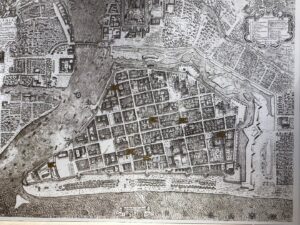
This map of the old city shows what it looked like during the Spanish era. It isn’t completely intact today, as damage from earthquakes and WWII is still quite apparent.
Fort Santiago, where we start our exploration, is located on the far left and lower side of the map. The churches and museums we visited are spread out across the center of the map, as shown by the flags.
As we venture further into the heart of Intramuros, hidden gems and untold stories await us at every corner. From the whispers of the ancient walls to the untold legends of the cobblestone streets, Intramuros holds the key to unlocking the mysteries of Manila’s past. Join us as we peel back the layers of history and delve into the enigmatic secrets that have shaped this historic city. Get ready to be amazed by the rich tapestry of tales waiting to be discovered within the walls of Intramuros. Now, let’s delve deeper into the heart of this historic enclave as we explore the forts and churches that have stood the test of time.
Intramuros Itinerary Part I: Explore the Fort
We begin our tour of Intramuros in Fort Santiago, set at the mouth of the Pasig River, a strategic position that once controlled access to Manila. Built by the Spanish in 1571 as part of Miguel López de Legazpi’s expedition, it stands on the site of an earlier wooden fort belonging to Rajah Sulayman, a local Muslim leader. We were surprised to learn about the Muslim presence in the Philippines, long before the Spanish arrived from Mexico.
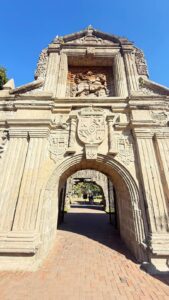
The purpose of the fort was clear: to defend Manila and protect the lucrative trade routes linking Asia, Mexico, and Spain. During the Spanish era, Fort Santiago served as both citadel and prison. Most famously, it held José Rizal before his execution in 1896. Dr. Jose Rizal is revered not for war, but for his intellect—his writing and quiet resolve helped shape a national identity and inspire a movement for independence. He is a true national hero, and you can actually visit his prison cell.
The imposing walls of Fort Santiago stand as a testament to the city’s resilient spirit, offering a glimpse into its storied past. As we wander through the ancient ramparts, we can feel the weight of centuries bearing down on us, each stone whispering tales of conquests and triumphs.
Reconstructed after the war, Fort Santiago is now one of Manila’s most important historical sites. Highlights include:
- Main Gate & Plaza Moriones — iconic stone entrance
- Dungeon ruins — haunting remnants of wartime imprisonment
- Rizal Shrine Museum — manuscripts, artifacts, and personal items
- Gardens & river views — surprisingly peaceful along the Pasig
Fort Santiago isn’t just a fortress—it’s where Manila remembers. Beneath the stone walls and quiet gardens lies a story of conquest, courage, and a nation finding its voice.
Intramuros Itinerary Part II: The Churches
Intramuros is filled with churches that each tell a different chapter of Manila’s story—Spanish power, wartime destruction, and modern resilience. Here’s a clear, story-driven way to understand them. The churches within Intramuros beckon us with their ornate facades and hallowed interiors. From the intricate carvings of San Agustin Church to the grandeur of Manila Cathedral, each place of worship tells a story of faith and devotion that has withstood the test of time. As we pause to admire the intricate architecture and centuries-old artifacts, we can’t help but be humbled by the enduring legacy of these sacred spaces.
The Manila Cathedral — The Grand Seat of the Church
We first stepped into the Manila Cathedral, the spiritual heart of Catholic Manila. Rebuilt time and again after earthquakes and war, what stands today reflects both resilience and devotion. The great bronze doors read almost like a storybook in relief, depicting how faith arrived and took root in the Philippines. Inside, the space feels grand and ceremonial—less intimate, more symbolic—a place where history and faith meet on a national scale.
This is the mother church of the Philippines—formally the Minor Basilica and Metropolitan Cathedral. It is elegant, resilient, and symbolic of the enduring power of faith through centuries of upheaval.
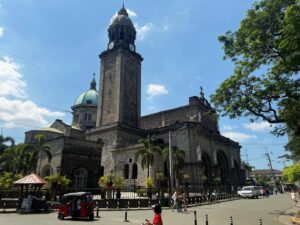
What makes it special and a must-visit:
- The original building was built in 1571, but was destroyed 7 times (earthquakes, fires, war)
- The current version dates to 1958, giving it a more modern Romanesque feel
- Beautiful stained glass, high dome, and bronze doors
- The seat of the Archbishop of Manila
Plaza Roma
The plaza directly in front of the cathedral is Plaza Roma. It’s the main square of Intramuros—the historic heart of Spanish Manila, and is near the Palacio del Gobernador (seat of Spanish colonial government). Plaza Roma opens like a stage before the cathedral—where Manila’s past once gathered in power and ceremony, and today invites a quieter kind of reflection.
At the center is a statue of King Charles IV of Spain, placed there in the 1800s as a gesture of gratitude after Spain sent smallpox vaccines to the Philippines.


Plaza Roma: Then vs. Now
- During the Spanish Colonial Era, this was the political and religious epicenter
- Today, it’s a graceful, open square—a place to pause, take photos, and absorb the scale of the cathedral
San Agustin Church — The Oldest Survivor
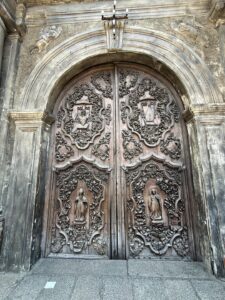
From there, we walked to San Agustin Church, the oldest stone church in the Philippines, completed in 1607. Built by Augustinian friars, it has survived earthquakes, fires, and the devastation of World War II, when much of Intramuros was destroyed. Today, it stands as a UNESCO World Heritage Site and a quiet testament to endurance. Here is a picture of the famous wooden carved entrance doors.
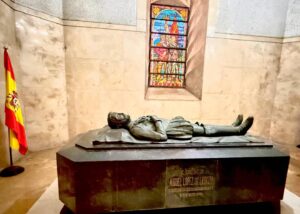
Inside, the ceiling is painted in trompe-l’œil, creating the illusion of depth and architecture where there is none—subtle, elegant, and unexpectedly modern in its effect. We saw the tomb of Miguel Lopez de Legazpi, linking us directly back to the founding of Manila.
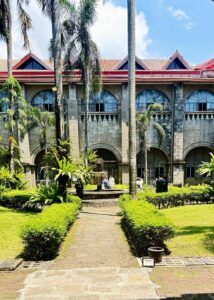
The church is connected to the San Agustin Museum. Outside, the cloister garden offered a different kind of moment—peaceful and timeless, yet alive with a newly married couple and their photographers. History and celebration, side by side.
San Ignacio Church — The Ruin Reimagined
Nearby, we stepped into the more reflective world of the Jesuits at San Ignacio Church. Here, the atmosphere shifts—less grand, more contemplative. The Jesuits were known for education and intellectual life, and that spirit lingers in the carvings and quiet spaces. It felt like a place not just of belief, but of thought—where faith was studied as much as practiced. Here is a statue of Saint Ignacio, the founder of the Jesuits.
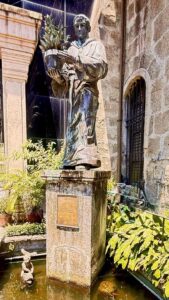
Originally built by the Jesuits in the 19th century, this church was destroyed in WWII and left in ruins for decades.
Today:
- Its remains are incorporated into the Museo de Intramuros (see below)
- A partial reconstruction lets you feel both past and present at once
- One of the most atmospheric sites in Intramuros
Intramuros Itinerary Part III: The Memorial and the Museums
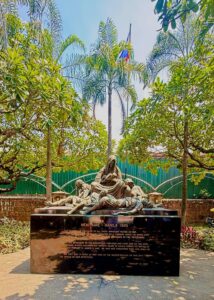
Just beyond the churches, a different kind of history reveals itself at the Memorare Manila 1945 memorial—a quiet, powerful tribute to the more than 100,000 civilians who lost their lives during the Battle of Manila in World War II. After the beauty and serenity of the churches, it’s a sobering reminder of how much this city has endured.
Museo de Intramuros
There are several, most interesting museums in Intramuros that are worth a visit. We decided to visit the namesake museum and found many interesting exhibits:
 Other Manila Museums
Other museums worth visiting in Manila are the National Museum of the Philippines and the National Museum of Fine Arts. Unfortunately, we didn’t have time to visit them, but they are worth a visit if you do.
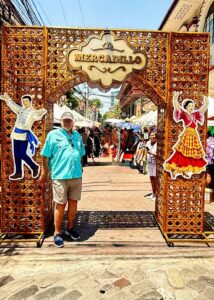
Intramuros Itinerary Part IV: The Mercadillo
Finally, we wandered into a lively mercadillo—music, color, and people everywhere.

After the stillness of churches and the weight of history, it felt like the perfect counterpoint.
Final Thoughts
If you need some help getting started with your travel planning, the best way is to check out our Guide to DIY Travel.
If you wish to learn more about other Southeast Asian Countries, and the best time to visit, including when to miss the heavy rains of the monsoon season, please visit our blog post “Best Time of Year to Travel to Southeast Asia.”
All places in Southeast Asia are worth visiting. Whether you’re exploring ancient temples, enjoying lantern-lit river rides, or indulging in world-class cuisine, there’s something magical here for every traveler. Here are some additional posts that you might want to visit to get more details about each country that Robin and Cos have visited:
- Top 10 Places to Visit in Vietnam
- Vietnam Best Time to Visit for Your Dream Vacation
- Beach Resorts Near Ho Chi Minh City: Vung Tau Vietnam Beach
- Phuket Tourist Places to Visit in Phuket, Thailand
- Visit Thailand: Bangkok and Phuket
- Best Time to Visit Singapore
- Visit Cambodia
- Visiting Malaysia Places to Visit
- Unique Intramuros Tour in Manila, Philippines
- How Many Days to Spend in Bali?
Conclusion
We certainly made the most of our short stay in Manila, and you can too.
Embark on a captivating journey through Manila’s historic walled city, Intramuros. Immerse yourself in the rich history and vibrant culture this unique walking tour offers. From exploring the forts and churches to uncovering the hidden secrets of Intramuros, each step you take is a step back in time. Don’t miss out on this enriching experience – book your tour today and discover Manila like never before. As you walk through the cobblestone streets and ancient walls, you will truly understand why Manila is a destination with a history worth exploring.
And in the famous travel words attributed to St. Augustine, “The World is a Book, and if you don’t travel, you have only read one page.”
0 Comments