

Romania is a land of storybook castles, rich history, misty mountains with breathtaking views, and medieval towns where history and culture still lingers in the air. It is a beautiful country. Whether you’re drawn to Transylvania’s Gothic legends, Bucharest’s Belle Époque architecture, or the serenity of the painted monasteries, this 10-day Romania itinerary blends culture, scenery, and charm in perfect measure. in this post we will tell you how to plan a 10-day romanian itinerary.
Contents
- 1 Okay, But Is Romania Worth Visiting?
- 2 Overview: Our Recommended 10-Days Romania Itinerary
- 3 Days 1-2 | Bucharest, the Capital City
- 4 Day 3 | Sinaia & Brasov— The Royal Mountain Retreat – Peles Castle
- 5 Day 4| Brașov & Bran — Gateway to Transylvania Region
- 6 Days 5-6 | Moldova Iasi &/or Suceava in Bucovina
- 7 Days 7-9| Cluj-Napoca, Sibiu, Hunedoara & Alba Iulia — Medieval Heart of Transylvania
- 8 Day 9 – 10 | Back to Bucharest
Okay, But Is Romania Worth Visiting?
Tucked between the Carpathian Mountains and the Black Sea, Romania is one of Europe’s most captivating yet overlooked destinations. Like many of the other countries in the Balkans, other than Croatia, the country simply hasn’t been marketed well in the United States. It’s a land of fairytale castles, painted monasteries, and medieval villages where time seems to stand still. Whether you’re tracing the legends of Dracula in Transylvania, driving the serpentine Transfăgărășan Highway, or sipping wine in the hills of Dealu Mare, Romania blends history, mystery, and heart in equal measure. Add to that its warm hospitality, authentic cuisine, and excellent value — and you’ll see why this beautiful country deserves a place on every traveler’s map.

Overview: Our Recommended 10-Days Romania Itinerary
| Day | Destination | Highlights | |
|---|---|---|---|
| 1 | Bucharest | Old Town, Palace of Parliament | |
| 2 | Bucharest | Open Museum, Capital City, Historic Center | |
| 3 | Sinaia – Brasov | Main Attraction: Peles Castle, King Carol, | |
| 4 | Brașov -Bran |
| |
| 5 -6 | Moldova Iasi &/or Suceava | Painted Monasteries, Palace of Culture | |
| 7 | Cluj-Napoca | Cafés, museums, nightlife, Turda Salt Mine | |
| 8 | Sibiu | Large Square (Piata Mare), Bridge of Lies, Astra Open Air Museum | |
| 8 | Hunedoara | Corvin’s Castle day trip and/or Transfăgărășan Highway | |
| 9 | Alba Iulia | Medieval Fortress / Citadel | |
| 10 | Return | Bucharest or onward travel |
Map of 10-Days Romania Itinerary
When to Visit Romania – Late October to See Transylvania Halloween
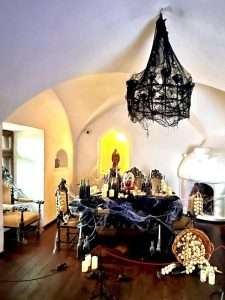
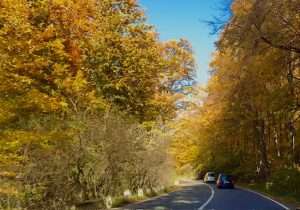
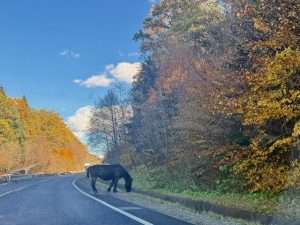
Robin and Cos visited in the Fall, mid to late October. Late October was highlighted by a visit to Dracula Castle with their Halloween Show in full force. Based on the following Dracula and fall foliage pictures, we trust you agree this is the best time to go and visit Romania to have a great time. If you are a skier you might want to visit in the winter, and the summer is also fine. But like so many places in Europe, the Fall Shoulder Season is your best choice and Spring is also a good time for Mild weather, wildflowers, and fewer crowds.






How to Get Around Romania
Assuming you are starting your trip in the Capital City of Bucharest, we can presume you arrived either at the Bucharest Airport, or came by river boat on the Danube from Budapest in Hungary. The City Centre of Bucharest is a short cab ride away from the Airport, or your river cruise should transport you into the city centre. We arrived by River Cruise, with Viking, and they transported us to the JW Marriott Hotel which is directly next to the Palace of Parliament.
We decided from Bucharest to make our trip around Romania to be a road trip which turned out not to be the smartest decision for a few critical reasons:
- The trip from Bucharest to Brasov on Route 1 is painfully slow and will take at least four and sometimes six hours to go the 105 miles. The train will make the trip in half the time, with an optional stop-off in Sinaia to see Peles Castle. Anything you can do to avoid the traffic jams on route 1 is highly recommended. Starting the road trip with a rental car from Brasov makes a lot more sense.
- Alternatively, if you want to travel just in Bucharest and Transylvania, then you can visit the main Transylvania cities by train and not rent a car at all. Traveling by train will allow you to visit the cities of Bucharest, Brasov, Sighisoara and Sibiu. You will not be able to visit the painted monasteries in Moldova, but you will save yourself a lot of headaches, as driving in Romania is a major hassle.
- According to our rental car company, Hertz, you will need an International Drivers Permit We didn’t have one. So, we took the risk of not getting stopped by never exceeding the very low posted speed limits and cutting our travel time in half, by altering our plans not to leave the country. The good news, we lucked out and ended up spending a few more days in Bucharest. But don’t make the same stupid mistake, we were told by the rental agent that the penalty if we got caught would be bad. However, during the late October 2025 road trip, we decide to check the internet and see what we could learn about International Drivers Permits and the laws in Romania. We learned that effective September 30, according to the Internet, IDP would no longer be required in Romania. Unfortunately we did not discover this until close to the end of our road trip.
- Speed limits are not posted on many roads, and it is critical to know the default speed limit laws. When passing through any city, the maximum speed limit is 50 kmh. The default speed limits on rural roads when you exit the city is 90 kmh, but his is hardly ever posted and sometimes it is only 70 kmh, You can’t rely on your GPS or car navigation to tell you the true speed limit as they often sent us conflicting messages.
International Drivers Permits and Laws in Romania
First, there is no such thing as an International Driver’s License. The official document is an International Driver’s Permit, which essentially will translate your home countries’ license into languages that the local country officials can understand. You must still carry your home country license.
Secondly, on September 25, 2025, Romania passed a new law effective September 30, 2025, that drivers from certain countries, including the USA, can drive in Romania for up to six months, with only their home country driver’s license. Since we were traveling in October of 2025, apparently no one told the Hertz rental car agency or the agent we dealt with that the law had changed. Wow, things could have been a lot less tense.
In any case, we still believe a road trip is still the best way to see the whole country, but start the road trip from Brasov, not Bucharest, and make sure the Rental Car company knows the law regarding International Drivers Licenses (Permits).
Days 1-2 | Bucharest, the Capital City
Bucharest often surprises travelers who expect “Dracula country” and instead find a cosmopolitan, creative capital that feels both Parisian and distinctly Balkan. Bucharest earned the nickname “Little Paris” in the early 1900s for its wide boulevards and elegant Belle Époque buildings. Today, it’s a fascinating blend: the monumental Palace of Parliament, chic Art Nouveau villas, and vibrant street art all coexist.
Walk down Calea Victoriei, and you’ll move through centuries of history in a single stroll.
In Lipscani (Old Town), cobblestone streets lead to hidden courtyards, churches, and boutique hotels tucked behind centuries-old façades. Nearby, Revolution Square tells the story of the 1989 uprising that ended communist rule — one of Europe’s most pivotal 20th-century moments.
In a Nutshell, Bucharest is not just a capital — it’s a conversation between past and present, elegance and edge, memory and reinvention. It’s a city that rewards curiosity and lingers in your mind long after you’ve left.
Things to do in Bucharest
-
First Stop: Wander Old Town (Lipscani District) for cafés and cobbled streets.
-
Tour the Palace of Parliament – book tickets in advance.
-
Stroll elegant Calea Victoriei and visit the Romanian Athenaeum.
-
Relax in Cișmigiu Park or Herăstrău Lake
- Visit the Village to see homes from around the ocuntry
Where to Eat & Stay – Restaurants and Hotels
Luxury hotels and fine dining come at a fraction of Western European prices. The quality of the top hotels is equal to other important European cities, the airport connects easily to the city and getting around the city through public transport or rideshare is easy and inexpensive.
Hotels
- The JW Marriott for shear elegance.

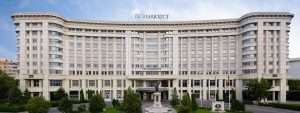
- The Marmorosch Hotel for boutique luxury

Restaurants
-
Caru’ cu Bere – traditional beer hall with live music, and a highlight for many tourist tour groups where every tile, mural, and archway tells a story. We ate there the first night of our visit. This place is a lot of fun, the wine is good, and the food portions are large. However the quality of the food was only fair. Here are pictures of Robin having the largest wiener schnitzel ever, dancing with the house dancers, and showing off our favorite wine,
- Vatra – looking for a true Romania restaurant without all the tourists, This is the place, We had great soups (meatballs and tripe) , stuffed cabbage, and Papanași, a Romanian and Moldovan traditional fried or boiled pastry made from fresh-cheese dough. It is usually served topped with cream and fruit confit.
- JW Steak – a great steak house in the JW Marriott Hotel. Super Tomahawk Rib-eye steak with free bottle of good red wine Just expect a big bill as well.


Travel Tip
Bucharest traffic can be slow – walk or use ride-share apps. Next, travel about two hours by train or car to Sinaia,or three or more hours to Brasov
Day 3 | Sinaia & Brasov— The Royal Mountain Retreat – Peles Castle
Visiting Peleș Castle in Sinaia is a must stop on your 10-Days Romanian Itinerary, Some travel experts consider it to be perhaps Europe’s prettiest royal residence, we agree. Commissioned by King Carol I in the late 1800s, it was originally built as a royal summer residence and hunting lodge. This neo-Renaissance masterpiece was a marvel of innovation for its time—featuring central heating, electricity, and even an early built-in vacuum system.
But what truly sets Peleș apart is the artistry: hand-carved woodwork, gilded ceilings, stained glass, and exquisite Murano glass mirrors, which were transported by water and then carried the last stretch by oxen to ensure their safe arrival. Every detail reflects the vision of a king who wanted to create not just a palace, but a symbol of Romania’s sophistication and pride.


You have the option to visit and stop in Sinaia on the trip from Bucharest to Brașov, or make it part of a day tour from Brasov. We did the second option and had a wonderful tour guide who we found on Viator.

Bran Castle and Peles Palace are two of Transylvania’s most iconic estates, but visiting them in the same day isn’t easy without private transportation. Ideal for travelers with limited time to spare, this half-day private tour ticks off both attractions in just a handful of hours, with round-trip hotel transfers from Brasov. Learn the real-life Dracula legend of Vlad the Impaler before visiting the ornately decorated 19th-century residence.
Day 4| Brașov & Bran — Gateway to Transylvania Region
Brasov and Bran are two of the most beautiful and atmospheric destinations in Transylvania — and together, they capture the region’s charm, legends, and mountain beauty. Here’s why they’re well worth a visit:
Top sights in Brașov
-
Council Square (Piata Sfatului) and colorful baroque façades

-
Black Church – the largest Gothic church in Romania

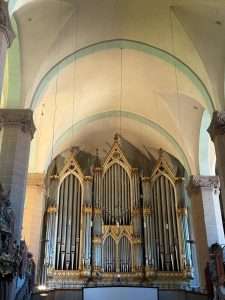
Bran – Dracula’s Castle
Take a day trip to Bran Castle, often called Dracula’s Castle. First read Bram Stoker’s Dracula and then get briefed on the real Dracula.

Sidebar: The Real Dracula — Between History and Legend
The Dracula of fiction was inspired, in part, by Vlad III of Wallachia, known as Vlad Țepeș or Vlad the Impaler (1431–1476). A fierce 15th-century ruler, he defended his land from Ottoman invasion with ruthless tactics that earned him both fear and fame. Bram Stoker never visited Transylvania, but drew on stories of Vlad’s cruelty and combined them with Carpathian folklore about vampires to create his immortal Count Dracula.
Days 5-6 | Moldova Iasi &/or Suceava in Bucovina
Having visited Brasov and Bran in the Eastern part of Transylvania, we recommend making the 5+ hour journey over to the Eastern Region of Romania, Moldova, and to the more Northwestern region, Bucovina. Bucovina is a distinct northern subregion of the historical Principality of Moldavia, shaped by centuries of Austrian influence — whereas Moldova refers either to Romania’s eastern region or the neighboring Republic of Moldova, both with more Eastern heritage.
The Moldova Region of Romania is bounded by the Carpathian Mountains to the west and the Prut River (the modern border with the Republic of Moldova) to the east. Iasi is the largest city, a university town, and is recognized by UNESCO as a City of Literature (2019).
A Brief Visit to Iasi
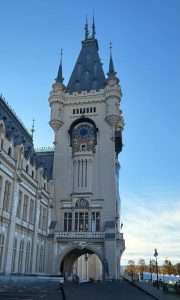
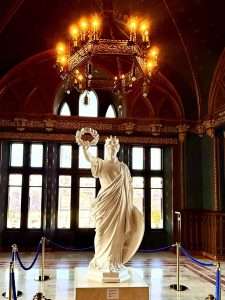
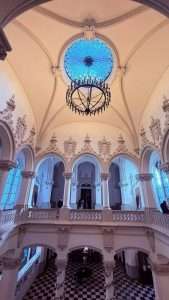
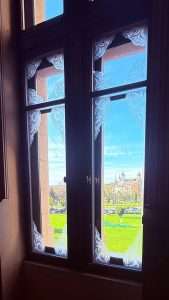
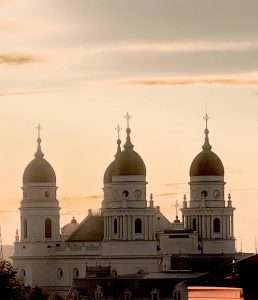
While in Iași, we visited the magnificent Palace of Culture, an enormous Neo-Gothic building that now houses four museums: Art, History, Science and Technology, and Ethnography. We especially enjoyed the Romanian cultural exhibits and the impressive collection of traditional tools and folk art. The grand hall was alive with joy that day—two brides were having their wedding photos taken amid the marble columns and stained glass! Later, we happened upon one of them again, about to enter her Orthodox church for the ceremony—a lovely glimpse into local tradition. From the Palace we also had a great view of the Three Hierarchs Monastery (1639), with an Intricately carved stone exterior; Vasile Lupu’s tomb lies here.
Moving Over to Suceava in the Bocovina Region, and the Painted Monasteries
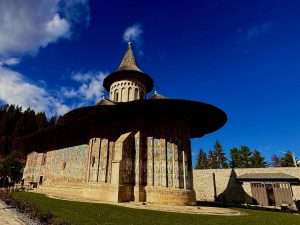
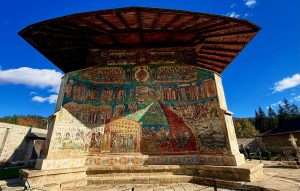
The next day, we drove through the Bucovina countryside, passing rolling hills and quiet villages, to reach the famous Voroneț Monastery—often called the “Sistine Chapel of the East.” The monastery’s frescoes are renowned for their intense Voroneț blue, a unique cerulean hue that has remained vibrant for over five centuries. The walls depict vivid biblical scenes rendered with extraordinary detail, set against a stunning mountain backdrop—truly a breathtaking sight.
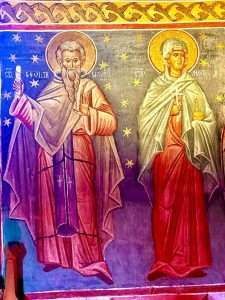
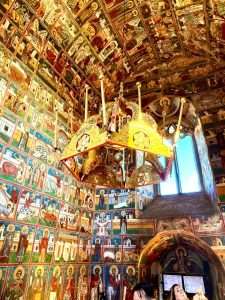
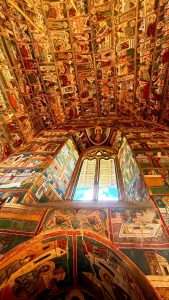
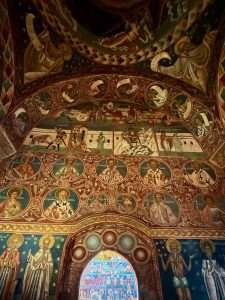
That evening, we checked into the Mandachi Hotel and Spa in Suceava, a modern four-star property founded by local entrepreneur Ștefan Mandachi, known both for his business ventures and his philanthropic efforts throughout Romania.
Days 7-9| Cluj-Napoca, Sibiu, Hunedoara & Alba Iulia — Medieval Heart of Transylvania
Having wandered over to the Northern and Eastern Regions of Romania, we return back to Transylvania, this time in the Western/Central Part of the Region.
10-Day Romania Itinerary: Cluj-Napoca
Romania’s second city blends medieval charm with café culture. Cluj’s airport has direct flights across Europe – ideal for departure, or as a secondary entry point for travel around Romania.
What to do:
-
Union Square & St. Michael’s Church
-
Matthias Corvinus House – 15th-century heritage
-
Central Park for a lakeside stroll
-
Ethnographic Park for village architecture
- Turda Salt Mine: an hour drive on the road to Sibiu. Descend 120 m underground to ride a Ferris wheel beneath glittering salt walls.
10-Day Romania Itinerary: Sibiu Must-Sees
Like Brasov, Sibiu is a great place to base a trip to search the Transylvania Region. Both the Corvin Castle in Hunedoara and the Fortress in Alba lulia.
What to do:
-
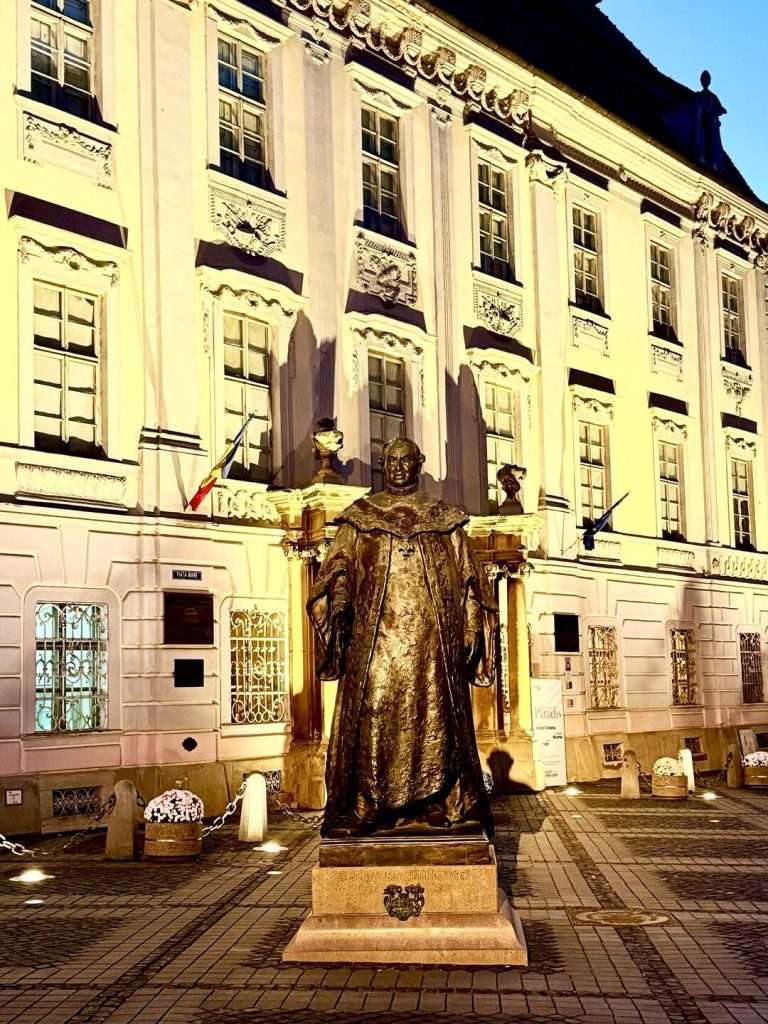
Large Square (Piata Mare)
-
The Bridge of Lies

-
ASTRA Open-Air Museum with traditional houses and windmills
We stayed at the Hilton Hotel, which is located in the forest west of town, and just down the road from the ASTRA Open-Air Museum.

10-Day Romania Itinerary: Hunedoara
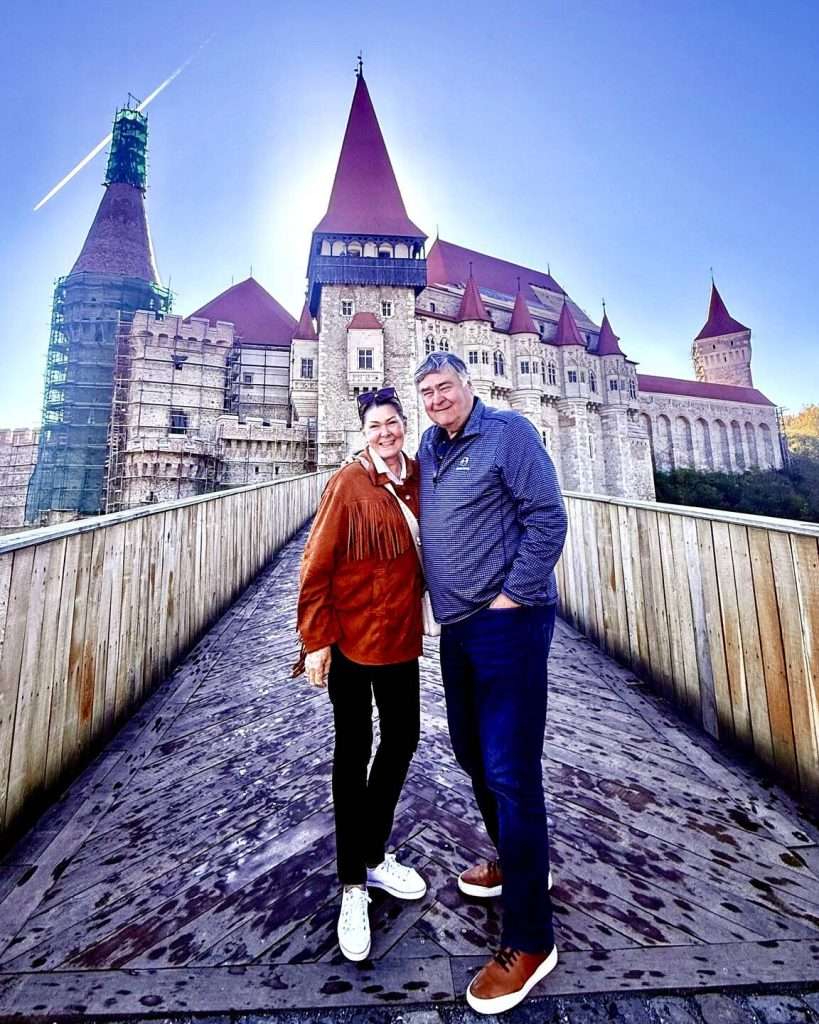
Take a day trip to Corvin Castle (Hunedoara) – a Gothic masterpiece with drawbridges and towers.

10-Day Romania Itinerary: Alba Iulia
Alba Iulia is often called “The Spiritual Capital of Romania” because it embodies key moments of Romanian history, architecture, and national unity.
1. The Alba Carolina Citadel
-
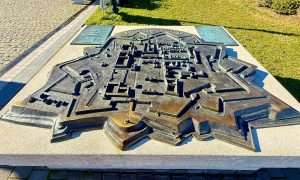
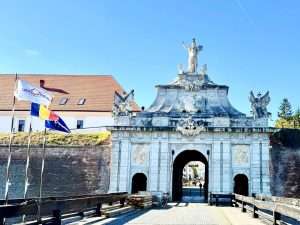
The star-shaped fortress is one of the largest and best-preserved Vauban-style citadels in Europe (built by the Habsburgs in the early 1700s).
-
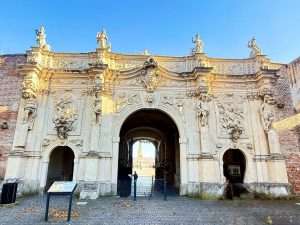
Its seven bastions, ornate gates, and changing-of-the-guard ceremony make it a highlight of Transylvania.
-
The citadel area is beautifully restored with cafes, museums, and wide promenades perfect for strolling.
2. The Birthplace of Modern Romania
-
On December 1, 1918, the leaders of Transylvania gathered here to proclaim the Union of Transylvania with Romania, forming Greater Romania — celebrated today as Romania’s National Day.
-
The Union Hall (Sala Unirii) and National Union Museum commemorate this momentous event.
3. Two Great Cathedrals, Side by Side
-
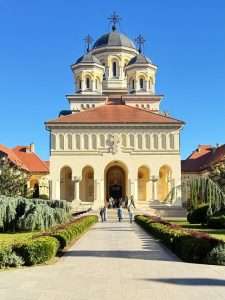
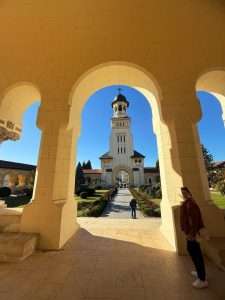
The Coronation Cathedral (Orthodox) was built for the 1922 coronation of King Ferdinand and Queen Marie, Romania’s first monarchs after unification.
-
Right next to it stands the Roman Catholic Cathedral of St. Michael, dating from the 13th century, one of the oldest and finest examples of Gothic architecture in Romania.
4. Layers of Civilizations
-
The city sits atop ancient Roman Apulum, once a major military center. Archaeological sites and museums showcase Roman ruins and artifacts from Dacian, Roman, and medieval times.
5. Atmosphere & Experience
-
Today, Alba Iulia feels open-air museum meets modern promenade — with bike paths, fountains, and panoramic views of the Mureș Valley.
-
It’s compact, walkable, and blends Austro-Hungarian precision with Romanian pride and spirituality.
Day 9 – 10 | Back to Bucharest
As you decide to leave the Transylvania Region and head back to Bucharest, one option is to travel on the infamous Transfăgărășan Highway from Sibiu to Curtea de Arges.
The Transfăgărășan Highway: “The Best Road in the World”
The Transfăgărășan Highway is also called “The Road to the Sky” or “Ceaușescu’s Folly”. Nicolae Ceaușescu, the leader of Romania’s Communist Era, ordered the road’s construction largely by hand, at enormous cost and with thousands of soldiers involved — an audacious project in Romania’s ruggedest terrain. Built between 1970–1974 the Transfăgărășan Highway was originally a strategic military route, meant to ensure quick access across the Carpathians in case of Soviet invasion. Today, it’s a bucket-list drive for travelers, motorcyclists, and car enthusiasts alike — famously dubbed by Top Gear’s Jeremy Clarkson as “the best road in the world.”
Driving Tips
-
Best time to go: Late June–October (the road is closed for snow the rest of the year).
-
Direction: North to south is more dramatic for photos, but both ways offer spectacular scenery.
-
Road conditions: Paved but winding — over 800 curves, steep hairpins, and long tunnels.
-
Allow: 3–5 hours including photo stops.
-
Fuel & food: Limited options mid-route — fill up before Curtea de Argeș or Sibiu.
Back in Budapest
Now that you are back in Budapest, before you plan to fly home, it is a good time to see many of the Bucharest sights that you missed on your first two days here. If you stayed at the JW Marriott on your first visit, stay at the Marmorosch Hotel for your second visit to experience these two great hotels.
Final Thoughts: Why Romania Belongs on Your Bucket List
A journey through Romania is a journey worth visiting, essentially a journey through time — from royal castles and Saxon villages to monasteries painted centuries ago. Ten days here reveal a country that is elegant, mysterious, and welcoming.
Whether you come for Dracula myths or Carpathian peaks, you’ll leave with something far more lasting: a connection to Romania’s authentic heart.
For information about other places to visit in the Balkans, please see our post Planning a Trip to Croatia, Greece and The Balkans.
0 Comments