

Contents
- 1 Why Visit Taipei?
- 2 How to Travel to Taipei
- 3 History of Taipei, Taiwan
- 4 Visit Taipei: Religion in Taiwan
- 5 Taipei’s Temples Including the Taipei Confucius Temple
- 6 Taipei Confucius Temple
- 7 Lin Family Mansion and Garden Taipei
- 8 Chiang Kai-Shek Memorial Hall Taipei
- 9 Changing of the Guard Ceremony
- 10 What is Taipei 101 Tower
- 11 Conclusion
Why Visit Taipei?
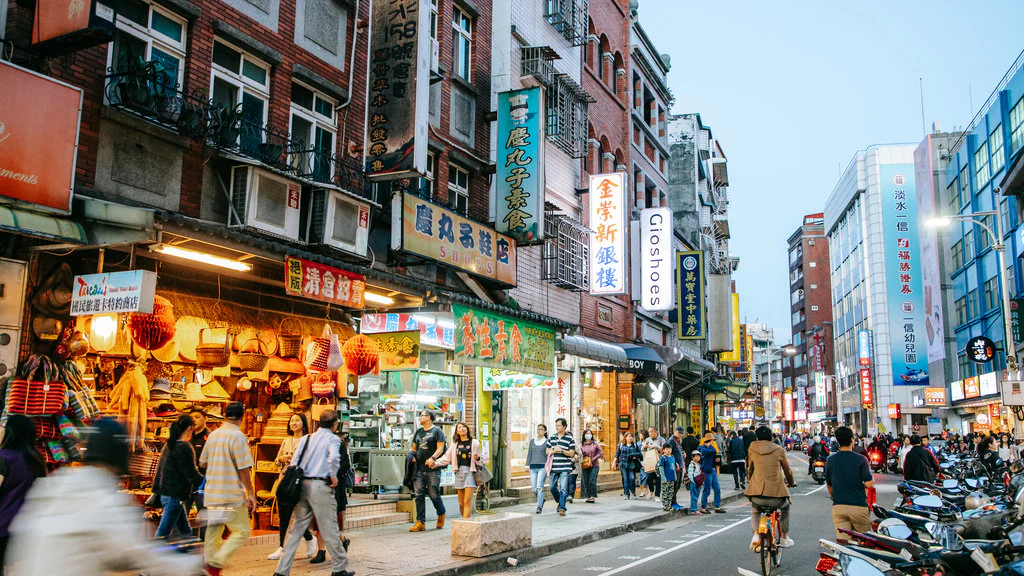
Taipei, the capital of Taiwan, is a modern metropolis with a 509-foot bamboo-shaped skyscraper, known as the Taipei 101 Tower for its number of floors. As one of the four tigers, Taiwan is a powerhouse of technology commerce, dominating today’s technology front. Taipei is a vibrant city that blends modern innovation with rich cultural heritage. Here’s why it’s worth a visit to Taipei:
- Night Markets & Street Food—Taipei is famous for its night markets, which offer everything from bubble tea to stinky tofu.
- Taipei 101 Tower – Taiwan tallest building, and once the tallest in the world, it offers breathtaking views from its observatory deck.
- Temples & History – Visit Dalongdong Bao-An Temple or explore the Chiang Kai-Shek Memorial Hall Taipei, or the Lin Family Mansion and Garden Taipei
- Natural Beauty – Hike Elephant Mountain for stunning city views or relax in Beitou Hot Springs.
- Shopping & Entertainment – From Ximending’s trendy boutiques to luxury malls, Taipei has something for every shopper.
- Day Trips – Explore Jiufen, a charming mountain town, or visit Shifen Waterfall for a scenic escape.
Taipei is also known for its friendly locals, efficient public transport, and safe and clean streets, making it an easy and enjoyable destination.
How to Travel to Taipei
Travel to Taipei is easy, with multiple options depending on where you’re coming from:
Travel Taipei By Air

- Taipei Taoyuan International Airport (TPE) is the main gateway for international travelers.
- Several airlines offer direct flights from the USA to Taiwan. China Airlines and EVA Air operate the most routes, departing from:
- Chicago (ORD)
- Houston (IAH)
- Los Angeles (LAX)
- New York (JFK)
- San Francisco (SFO)
- Seattle (SEA)
- Delta Air Lines, Starlux Airlines, and United Airlines also offer direct flights.
- Starlux Airlines will launch Phoenix (PHX) to Taipei (TPE) nonstop flights starting February 2026. This will be Phoenix’s first direct flight to Asia
- Taipei Songshan Airport (TSA) serves regional flights, mainly from China, Japan, and South Korea.
- Direct flights are available from major cities worldwide.
Travel Taipei By Train
- Taiwan’s High-Speed Rail (HSR) connects Taipei to cities like Taichung, Tainan, and Kaohsiung.
- The Taiwan Railways Administration (TRA) offers slower but scenic train routes.
Travel Taipei By Bus
- Long-distance buses operate between Taipei and other cities, offering a budget-friendly option.
Travel Taipei By Cruise Ship
- Our visit to Taipei was by Cruise Ship.
- Taipei’s main cruise port is Keelung Port, located about 24 km northeast of Taipei. It serves as the primary gateway for cruise passengers visiting Taiwa
- Transport to Taipei – You can reach Taipei in 45-50 minutes by train or bus
Getting Around Taipei
- The MRT (subway) is the most efficient way to explore the city.
- Buses and taxis are widely available.
- Renting a scooter or using YouBike (bike-sharing) is great for short distances.
History of Taipei, Taiwan
Taiwan has a fascinating history shaped by indigenous cultures, colonial rule, and modern political developments.
Flag of Taiwan

Early History
- The island was inhabited by Austronesian indigenous peoples for thousands of years.
- Chinese records mention Taiwan as early as the 3rd century BCE.
- Portuguese sailors in the 16th century named it “Ilha Formosa” (Beautiful Island).
Colonial Period
- The Dutch (1624–1662) and Spanish (1626–1642) established settlements.
- In 1662, Koxinga, a Ming loyalist, expelled the Dutch and ruled Taiwan.
- The Qing Dynasty annexed Taiwan in 1683, governing it for over 200 years.
Japanese Rule (1895–1945)
- After the First Sino-Japanese War, Taiwan was ceded to Japan in 1895.
- Japan modernized Taiwan’s infrastructure and economy.
- Taiwan remained under Japanese control until World War II ended in 1945.
Modern Era
- In 1949, after the Chinese Civil War, the Republic of China (ROC) government fled to Taiwan.
- Taiwan developed into a thriving democracy and a global economic powerhouse.
- Today, Taiwan is a self-governing entity, though its political status remains a topic of international debate.
Relationship to Mainland China
Taiwan has been shaped by its ties to mainland China and Japan’s rule until 1949. Under the former leadership of Chiang Kai-shek, it maintains its own identity as the independent Republic of China. As a former member of the UN, it initially successfully prevented the mainland People’s Republic of China from becoming a member.
Visit Taipei: Religion in Taiwan
Given the close historic ties to Mainland China, for the most part, the people of Taiwan are polytheistic, practicing a blend of Buddhism, Daoism and Chinese Folk Religion. Nevertheless, thanks to democratic reforms over the past few decades, religious diversity is a cherished and protected right, allowing the people of Taiwan the freedom to practice any faith they choose. Nevertheless, the large temples in Taipei reflect the three principle Chinese religions, Buddhism, Daoism and Confucianism.

Taipei’s Temples Including the Taipei Confucius Temple
Embark on a spiritual journey through Taipei’s most breathtaking temples and sacred sites. From the Dalongdong Bao-AnPao-an Temple to the Taipei Confucius Temple, immerse yourself in the rich religious culture of Taipei and discover the hidden spiritual gems of the city.
The Dalongdong Bao-An Temple
Also known as the Pao-An Temple, the Dalongdong Bao-An Temple in Taipei’s Datong District is considered the largest and the number one temple to visit in the city.

The temple has been recognized by the UNESCO Asia-Pacific World Heritage Awards for Cultural Heritage Preservation, and is regarded as a Taiwanese national treasure. With over two centuries of history, Baoan Temple is dedicated to Baosheng Dadi, also known as Emperor Baosheng. He is a venerated god of health and medicine. The temple is covered with ornate woodcarvings by masters from generations past, Koji pottery, couplet-inscribed columns and large murals.
Born in 979 A.D., Baosheng Dadi began his adult life as an imperial official. Soon, news spread of the medical miracles he was said to perform. As time went on, other Confucian, Buddhist and Daoist gods were added to the temple alongside Baosheng Dadi.
Beautiful Art Work
The interior of the temple contains beautiful art work including pictures of the Emperor and beautiful lanterns.


Musical Instruments
The Dalongdong Bao-An Temple contains many examples of traditional Chinese gongs and various musical instruments.


Worshipping at the Temple
Worshipping at the Temple is a rather unique process. Worshippers will tell each god their name and where they live, and can tell the gods what their issue is, whether it’s children, or health, or work. They can then toss the fortune blocks onto the floor. Based on the pattern that the blocks make on the floor, if the worshipper gets an affirmative answer, they can then take a fortune stick. This will indicate a specific slip of paper with their fortune on it, which we can be interpreted by people at the temple.
Because of Baosheng’s medical connection the people at the temple used to be able to issue prescriptions for the recommendations from the fortunes. However, the government no longer permits the temple to issue prescriptions.
Taipei Confucius Temple
The Taipei Confucius Temple is located a short walk from the Pao-An Temple. Although transformed over time, Confucianism is still the substance of learning, the source of values, and the social code of the Chinese. The Taipei Confucius Temple is a wonderful representation of those principles. Visiting with a guide can provide a significant understanding of the philosophy.
The Lingxing Gate, which is the main entrance, symbolizing the threshold to wisdom and learning. However, it is permanently closed since no one has been able to pass the ultimate Confucius test for wisdom.

The temple demonstrates how many mathematical concepts were understood by Chinese scholars long before they were known in the western world. We also saw a demonstration of Chinese calligraphy.

Lin Family Mansion and Garden Taipei
The Lin Family Mansion and Garden Taiwan is a stunning example of traditional Chinese garden architecture. Built in 1847 by the Lin Ben Yuan family, it is one of Taiwan’s most well-preserved historical sites. The garden features intricate pavilions, artificial landscapes, and serene ponds, making it a popular spot for photography and cultural exploration.
The mansion and gardens provide a great background for traditional Chinese wedding pictures.


The Lin Family Mansion and Garden Taipei is a must-visit destination for anyone interested in history, culture, or simply enjoying a peaceful retreat in the midst of a bustling city.
Chiang Kai-Shek Memorial Hall Taipei
The Chiang Kai-shek Memorial Hall Taipei is a prominent landmark and historical site dedicated to Chiang Kai-shek, the former President of the Republic of China. Located in Liberty Square, the memorial hall is surrounded by beautiful gardens and flanked by the National Theater and National Concert Hall.

Chiang Kai-shek was a pivotal figure in 20th-century Chinese and Taiwanese history. He served as the leader of the Republic of China from 1928 to 1949 and later led the government in exile in Taiwan until his death in 19752.
The architecture of the Chiang Kai-shek Memorial Hall Taipei is striking, with its white walls, blue octagonal roof, and a grand staircase of 89 steps, symbolizing Chiang’s age at the time of his passing. Inside, you’ll find a large bronze statue of Chiang Kai-shek, a museum documenting his life and Taiwan’s history, and exhibition spaces.

Historically, Chiang is known for:
- Unifying China: As the successor to Sun Yat-sen, he led the Nationalist Party (Kuomintang) and successfully unified much of China during the Northern Expedition in the late 1920s.
- Opposition to Communism: Chiang was a staunch opponent of the Chinese Communist Party, leading to a prolonged civil war that ultimately resulted in the establishment of the People’s Republic of China under Mao Zedong.
- Role in World War II: During the Second Sino-Japanese War, Chiang’s leadership placed China among the Allied Powers, earning it a seat as one of the “Big Four” nations.
- Taiwan’s Development: After retreating to Taiwan in 1949, Chiang’s government laid the foundation for Taiwan’s modernization and economic growth, though his rule was marked by authoritarianism

However, his legacy is complex, with some viewing him as a unifier and modernizer, while others criticize his authoritarian policies and the suppression of dissent. As shown by his lucky “888” bullet-proof car he lived well.

He hosted many other prominent people in addition to Roosevelt and Churchill.


Changing of the Guard Ceremony
One of the highlights of the Memorial is the changing of the guard ceremony, which takes place hourly and is a popular attraction for visitors. The site is not only a place of historical significance but also a cultural hub, hosting various exhibitions and events.

After the ceremony was over, Cos was almost run over by the off-duty guards who were headed back to their rest area:

What is Taipei 101 Tower
The Taiwanese people are very proud of their 101 story high office tower, known as Taipei 101. It is an interesting building made in the shape of bamboo. At one point it was the tallest building in the world, but no longer can it make that claim.

Taipei 101 Tower is an architectural marvel and a symbol of Taiwan’s progress and innovation. Here’s a brief overview of its history and significance:
History of Taiwan Tallest Tower
- Construction: Built between 1999 and 2004, Taipei 101 was designed by C.Y. Lee and Partners. It officially opened on December 31, 2004.
- Design: The building’s design incorporates traditional Chinese elements, such as its resemblance to a bamboo stalk, symbolizing growth and resilience.
- Engineering Feats: It was the first skyscraper to exceed half a kilometer in height and features a tuned mass damper to withstand earthquakes and typhoons.
Importance
- Cultural Icon: Taipei 101 is a symbol of Taiwan’s economic and technological achievements. Its design reflects a blend of tradition and modernity.
- Sustainability: In 2011, it became the tallest green building in the world, earning a LEED Platinum certification for its energy efficiency and eco-friendly design.
- Tourism and Economy: The building houses offices, a luxury shopping mall, and an observation deck, making it a major tourist attraction and economic hub.
- Global Recognition: Its New Year’s Eve fireworks display is a globally recognized event, drawing attention to Taiwan’s vibrant culture. It was the first skyscraper to support a fireworks show.
Conclusion
As we left Taipei on our cruise ship, we spotted a big Buddha on the side of a mountain.

It was a nice way to conclude our visit to Taipei. Out visit was very short, and there was much we didn’t have time to see. Being a country with many mountains we understand it is a great place to hike. If you are interested in visiting Taipei, we highly recommend you first check out Trip Advisor to find what else might be of interest to you. If you are looking for a guided tour we suggest you check out Get Your Guide.
Travel smarter, dine better and explore deeper: we’d love to share our handpicked insights and exclusive guides in our monthly newsletter below.
0 Comments