

 Source: https://iwgia.org/en/resources/indigenous-world.html
Contents
- 1 The World’s Indigenous People
- 2 Why Indigenous People Are Important
- 3 Our Visits to Indigenous People Around the World
- 4 Overall Treatment of Indigenous People Around the World
- 5 Backgrounds of Different Indigenous Cultures
- 6 Reparations for Indigenous People
The World’s Indigenous People
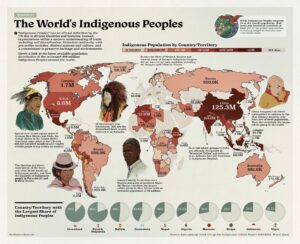
Indigenous peoples are the original inhabitants of regions across the globe, with deep cultural, spiritual, and historical ties to their ancestral lands. From the Maori of New Zealand to the Sami of northern Europe and the Aboriginal Australians, these communities preserve rich traditions, languages, and knowledge systems passed down for generations. Despite facing centuries of colonization, displacement, and cultural suppression, many Indigenous groups continue to advocate for their rights, protect their environments, and revitalize their cultural heritage, offering invaluable perspectives on sustainability, community, and the relationship between people and the natural world.
Please note that the following graphic is based on data from the United Nations Report cited above. The definitions of indigenous peoples and the counts are based on data from individual countries. Generally, they are defined as being the earliest known inhabitants of a place.
 Source: https://www.visualcapitalist.com/cp/mapped-the-worlds-indigenous-peoples/
Why Indigenous People Are Important
Robin and I have found “Indigenous People” or “First Peoples” to be an important educational learning experience as we have traveled the globe. Growing up in America, we knew very little about Indigenous People other than what we might have learned about American Indians from “Cowboy and Indian” movies. Clearly, this was not providing a sound education about Indigenous Peoples around the World, let alone in the Americas.
Traveling the world has taught us a lot about First Peoples. But sadly, it has only opened the book for us to learn about Indigenous People. This 700+ eBook, published by the United Nations, offers additional educational resources.
Another book that we recently read is “Guns, Germs, and Steel” by Jared Diamond. As a well-accomplished anthropologist, he does an excellent job of dispelling the myth that First Nations People are not as smart as their “Conquistadors”.
Indigenous Peoples Speak the Majority of the World’s Languages
Indigenous languages are extensive, complex systems of knowledge. They are central to the identity of Indigenous peoples, to the preservation of their cultures, worldviews, and visions, and to expressions of self-determination.
At least 40 percent of the world’s 7,000 languages are at some level of endangerment. It’s estimated that one of the native languages dies every two weeks. In 2022, the United Nations marked an important milestone project with the Decade of Indigenous Languages (2022 – 2032).
First Nations Communities are Protectors of the Environment
Indigenous peoples are inheritors and practitioners of distinct cultures and ways of living. Nearly 70 million depend on forests for their livelihoods, and many more are farmers, hunter-gatherers, or pastoralists. These communities thrive by living in harmony with their surroundings and caring for their natural resources. Research shows that where Indigenous groups have control of the land, forests, and biodiversity flourish.
Indigenous communities’ contribution to fighting climate change is far greater than previously thought. Their forestlands store at least one quarter of all above-ground tropical forest carbon – about 55 trillion metric tonnes. This is equivalent to four times the total global carbon emissions in 2014. Given that data isn’t available for all the lands native communities manage around the world, the actual impact is far greater.
Our Visits to Indigenous People Around the World
Coming from the United States, we clearly had a lot to learn in our own country and around the world. Here in the US, we traveled to South Dakota, Arizona, Alaska, Hawaii, Florida, the Cherokee Nation of Carolina, and Oklahoma. We learned a lot. (Check out the First Peoples articles in the underlined linked states. The Cherokee Nation is still to be developed.)
This full article is still under development. See the Canada, New Zealand, Australia, Panama, and French Polynesia Posts for some additional information about First Peoples around the Globe.
Overall Treatment of Indigenous People Around the World
One thing we have noticed is a general disparity in how First Peoples are treated worldwide. With the exception of New Zealand, we found that most of the English colonial states still treat the Indigenous People as second-class citizens. The United States, Canada, and Australia are all trying to do a better job, but they don’t provide the public recognition and acceptance that is apparent in New Zealand. Perhaps this is because of the relative size of the Indigenous population in each country, or other reasons. We will explore the differences.
The other big difference is the techniques that were used in each of these countries to get the Indigenous People to accept the European cultures and religions. We won’t get into the details here, but it is truly a sad point in each country’s history, given the techniques used to separate the first peoples from their cultures and beliefs. We also raise the question of why these techniques did not work as well in the Asian nations.
Backgrounds of Different Indigenous Cultures
First, we will share what we learned in each place we visited, and then get into the difficult questions that we raised.
Polynesian People
The Polynesian people may be the most interesting of all the indigenous peoples because they covered so much territory. The map below shows just how big their influence is.
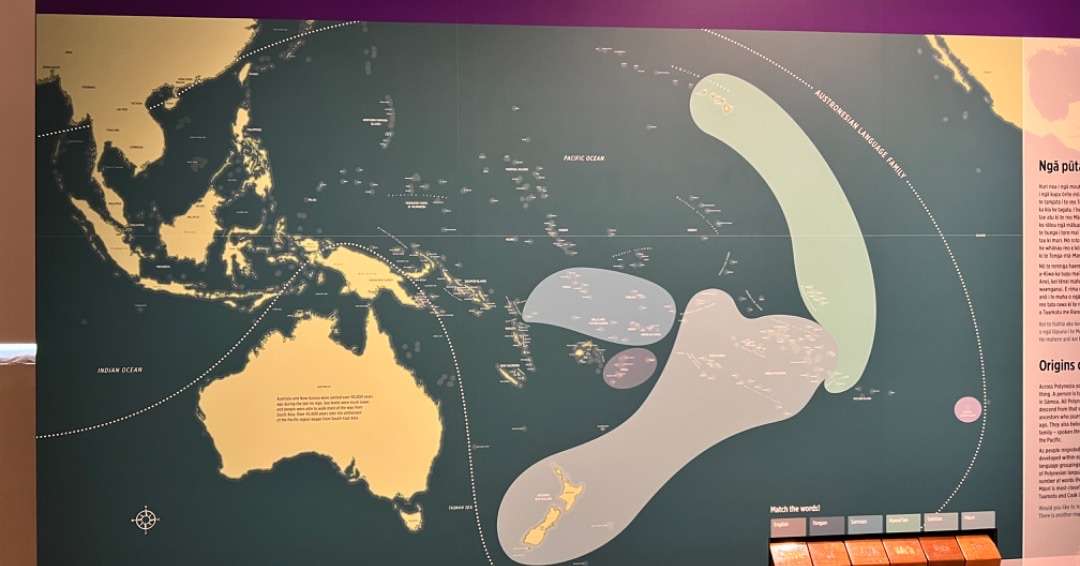
From New Zealand on the Western side, to Easter Island on the eastern side, Hawaii to the north, to French Polynesia to the south, they occupied an enormous number of islands in the Pacific Ocean. Their navigational skills, using the stars, were key to their ability to reach so many different places. One of the great places to learn about the Polynesian People is the Polynesian Center on Oahu in Hawaii.
How these people were treated once the Europeans and Americans reached these islands is in most cases a sad story. While fairly similar in most places, after a brief period of cooperation, war would eventually break out. Then, after losing most of the battles, the natives were normally forced to accept a foreign takeover.
Today, the Maori in New Zealand are treated more like equals. However, the path to cooperation was not without a lot of fighting and other challenges. For more details, see our article on New Zealand.
Indigenous People in the United States of America
Historically, Indigenous People, better known as Native Americans, were not treated well. In particular, the Cherokee, Muscogee, Chickasaw, Seminole, and Choctaw Indian Tribes were forced to abandon their Southern homes and move west to Oklahoma between 1831 and 1903. This sad tale, known as the “Trail of Tears,” is a part of American History that most people want to forget. Unfortunately, the actions that are taking place in the U.S. today to forcibly rid the country of illegal immigrants at gunpoint are a reminder to the descendants of the people who were similarly forcibly removed from their homes.
Recently, in the United States, several bills have been introduced in Congress seeking to provide reparations for Indigenous People. These bills seek to provide restitution for the long-term damage caused by colonialism and the broken treaties that followed. They also seek to provide access to education and healthcare, and to recognize Indigenous rights and culture. Over the years, the US has tried various forms of reparations. This has included giving the tribes land grants and independent governing authority. The unique privileges that tribes were given to build and operate casinos on their lands have been successful. It addresses the life expectancy, education, and other differences that the Indigenous People have suffered. The Poverty and Race Research Action Council has some interesting articles on this topic.
Indigenous People in Alaska Native Villages
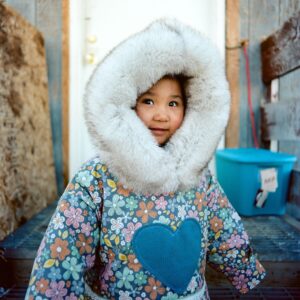
Alaska has the highest proportion of Indigenous people in the United States and in North America. American Indian and Alaska Native people make up about 13.2 per cent of Alaska’s population.
 Source: National Geographic
The U.S. government has taken a number of major actions—especially around land rights, self-governance, and health care—to support Alaska Native peoples, though outcomes have been mixed. The U.S. approach in Alaska has focused heavily on land settlements, economic structures (via Native corporations), tribal self-governance, and federally supported health and social services. While these policies created unique economic opportunities and greater autonomy, challenges remain—particularly in health outcomes, infrastructure, and equitable funding.
Policies of the Current U.S. Government
Indigenous People in Canada
Statistics from Statistics Canada show that Indigenous peoples—defined as First Nations, Inuit, and Métis—are a growing and vibrant part of Canada’s population. The number of indigenous people is about 1.8 million (roughly 5 per cent of the population as of the 2021 Census). They are, on average, younger than the non-Indigenous population and are one of the fastest-growing demographic groups in the country.
At the same time, the data highlight persistent disparities. Indigenous communities experience lower average incomes, higher unemployment rates, and lower high school and postsecondary completion levels compared to non-Indigenous Canadians. Health indicators also show gaps, including shorter life expectancy and higher rates of chronic conditions. Housing remains a challenge in some areas, with higher rates of overcrowding and homes in need of major repairs, particularly in remote communities.
However, the statistics also point to important progress and resilience—including rising education levels, growing urban Indigenous populations, and stronger cultural revitalization, such as increased use and teaching of Indigenous languages. Overall, the data reflect both the ongoing impacts of historical policies (like residential schools) and the continuing efforts of Indigenous peoples to strengthen their communities and futures.
In Canada, the government has taken steps to recognize the wrongs done to Indigenous People and to make amends. In 2016, the government launched the Truth and Reconciliation Commission.
Their job was to examine the history of Indigenous Peoples in Canada. The commission made 94 calls to action, which include measures to provide reparations for communities where children were taken from their families and forced into Catholic schools for essential cultural change. These measures include financial compensation, land restitution, and access to education and healthcare. Canada is following through with payments, including to individuals who participated in a legal suit against the government. The Catholic Church had also committed to fund these reparations, but so far is behind in raising the necessary funds.
Indigenous People in Panama
There are seven different groups of Indigenous people living in Panama today. During two different visits to the country, we spent time with the Kuna and the Embera. They are very friendly people, and they contribute a lot to the country’s culture. They make up 12% of the population. And 65% of the population has some indigenous genes, which is very high for any country. As a result, much like New Zealand, the indigenous people are treated with respect in the country.
Indigenous People in New Zealand
In New Zealand, reparations are more than just a political issue. It is also a legal issue, since statements protecting Māori lands were made in the 1840 Treaty of Waitangi (see New Zealand Post for more information about the treaty). The problem is that there are different interpretations of the commitment to protect land ownership in the English and Māori versions of the treaty. New Zealand has begun reparations. However, the governing principle is that reparations are for the tribe, not for individual people. This principle is generally followed in other countries when land ownership is the issue.
Indigenous People in Australia
In Australia, there is a similar problem as with Canada, where children were forcibly taken from their families to become acculturated. In 2021, the Prime Minister announced that roughly 380 million Australian Dollars would be set aside to compensate descendants of those wronged. For more about the Aboriginal People, please see our Australia Post.
The debate about reparations for Indigenous People is complex and contentious. There are those who argue that reparations are necessary to right the wrongs of the past and to provide a measure of justice to Indigenous people. There are also those who argue that reparations are not a viable solution and that they will not address the underlying issues of colonialism and oppression.
Asian Countries and Their First Peoples
We found it very interesting that in all the countries we visited in Asia (Japan, Singapore, Indonesia, Thailand, the Philippines, Vietnam, and Cambodia), attempts to colonize them were not as successful as in other places we visited. Okay, many of these countries did have European dominance for a significant period: the French in Indochina, the Portuguese in Thailand, the Spanish in the Philippines, the Dutch in Indonesia, the British in Singapore, etc. Also, the Chinese presence in almost all these countries has been very real. But we see that Asian countries today are very independent. The former colonizers are not well respected in these countries. For example, in Indochina, the French are not well thought of at all.
So why did the European influence in places like the United States, Canada, the Caribbean, French Polynesia, New Zealand, and Australia have such an impact in introducing European beliefs on First Peoples’ cultures and religions, but not so much in Asia?
We have pondered this question. What we have come to believe is that the Buddhist and Hindu religious practices are much stronger in uniting the First Peoples of the Asian Countries than the Polynesian, Aboriginal, and American Indian First Peoples cultures.
Reparations for Indigenous People
The following is an article about reparations for the First Peoples in different countries. This is not an article about reparations for slavery descendants. We believe these are two different subjects.
The debate about reparations for Indigenous Peoples has been ongoing for centuries. Indigenous Peoples have suffered displacement, genocide and cultural oppression at the hands of colonial powers and their descendants. In recent years, the conversation about reparations has shifted from one of guilt and retribution to one of restitution and healing.
The concept of reparations for Indigenous Peoples is rooted in the idea of restoring what was taken from them. It includes both material compensation and symbolic recognition of the wrongs they have suffered. This could include financial payments, land restitution, access to education and healthcare, and the recognition of Indigenous rights and culture.
Role of Missionaries
The missionaries who led the attempts to convert Indigenous Peoples were able to convince the First Peoples that they needed to change. This may be because their religious practices were not as well ingrained as with the Asian communities. However, there were few arguments for converting the First People who were Buddhist or Hindu because those religious and cultural practices were much more aligned with Western Christian and Muslim beliefs. For example, it was easy to convince Indigenous Peoples who practiced human sacrifice or polygamy that these were not good practices. And it made more sense for their leaders to adopt to the Western beliefs.
We don’t know if our observations are 100% percent correct. So we encourage our readers to comment and share your own thoughts on this subject.
0 Comments